In the Paint: Ernie Barnes and the Art of the Game
Hampton Art Lovers presents In the Paint: Ernie Barnes and the Art of the Game, a major exhibition drawn from The Norwood Collection and presented as a companion exhibition to Get in the Game: Sports, Art, Culture at Pérez Art Museum Miami.
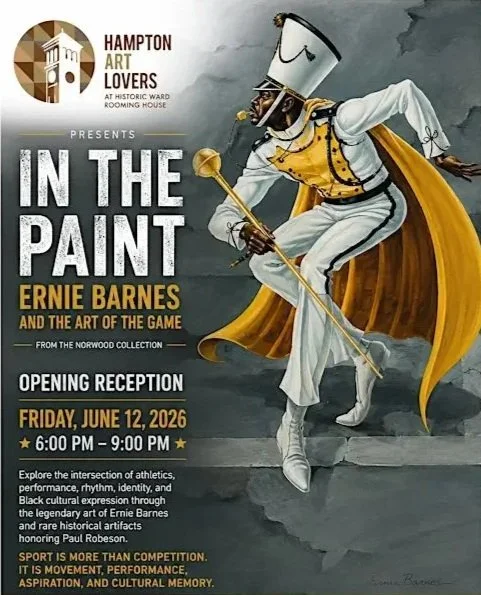
Centered on the work of legendary artist and former professional football player Ernie Barnes, the exhibition explores the intersection of athletics, performance, rhythm, identity, and Black cultural expression. Through limited edition hand-signed works by Barnes, historic photography, Olympic imagery, sculpture, and rare archival material related to Paul Robeson, the exhibition examines how sport functions as both competition and cultural performance.
Highlights include Barnes's celebrated Portfolio of Football Art, Dreams Unfold, The Drum Major, Head Over Heels, Olympic works, historic boxing photographs by Herb Scharfman, The Athlete's Nightmare by Barrington Watson, a maquette by Basil Watson, and a special section devoted to Paul Robeson featuring rare theatre programs, recordings, and cultural ephemera documenting his remarkable life as an athlete, actor, singer, and activist.
Presented in Miami's historic Overtown neighborhood, In the Paint positions athletics within a broader tradition of Black creativity, discipline, improvisation, and public expression. Inspired by the energy of straight-ahead jazz, the exhibition invites visitors to experience sport not simply as a game, but as a language of movement, aspiration, and cultural memory.
Join us for an evening of art, music, conversation, and community as Hampton Art Lovers celebrates one of the most dynamic intersections of sports and culture in Miami during the summer of the FIFA World Cup.
Admission is Free
RSVP Required
In the Paint: Ernie Barnes and the Art of the Game is presented as a companion exhibition to Get in the Game: Sports, Art, Culture at Pérez Art Museum Miami. While that exhibition situates sport within a broad global and cultural framework, this presentation offers a focused exploration of Black athletic movement, performance, rhythm, and visibility through works drawn from The Norwood Collection.
At the center of the exhibition is the work of Ernie Barnes, the celebrated artist and former professional football player whose paintings transformed the athletic body into a powerful visual language of motion, improvisation, tension, and grace. Barnes’s figures do not merely depict movement—they embody it. Elongated and rhythmic, his compositions capture the sensation of exertion, anticipation, collision, and release from the inside out.
Barnes’s work can be understood through the language of straight ahead jazz—structured yet improvisational, disciplined yet expressive. Like jazz musicians working within a composition while discovering freedom inside it, Barnes’s figures move across the picture plane with syncopation and elasticity. Repetition and variation coexist. Bodies stretch, lean, collide, and resolve like visual phrases carried by rhythm and momentum. In this way, the athlete becomes not only a competitor, but also a performer improvising within the structure of the game.
The exhibition opens with a section devoted to Paul Robeson, establishing performance itself as a foundational framework for understanding athletics, embodiment, and public visibility. Through archival theatre programmes, concert ephemera, and commemorative material—including Othello, Show Boat, and the Salute to Paul Robeson cultural celebration—the exhibition presents Robeson as athlete, actor, singer, and global cultural figure.
Robeson’s extraordinary career and subsequent persecution during the McCarthy era reveal the complicated relationship between Black excellence, public influence, and political consequence. At the height of his career in the 1940s, Robeson earned the equivalent of more than $2 million annually in today’s dollars, placing him among the most prominent cultural figures of his era. Yet because of his outspoken political advocacy and commitment to justice, he became the target of intense political persecution. Blacklisted, surveilled, and stripped of his passport, his income collapsed dramatically, revealing the consequences that can accompany visibility and influence when they are used to challenge injustice.
Robeson’s presence establishes a larger historical context for the exhibition: the Black body not only as a site of athletic achievement, but also as a site of performance, intellect, cultural production, and resistance.
From this foundation, the exhibition moves into the neighborhood arena, where athletic identity first takes shape. Works such as Head Over Heels, Main Street Pool Hall, and The Drum Major connect sport to community life, rhythm, ritual, and collective performance traditions deeply rooted within Black culture. Alongside these works, Alonzo Adams’s Basketball Scene extends this visual language of movement and improvisation through everyday spaces of play and gathering.
The exhibition then turns toward anticipation and competitive intensity. In The Bench, Barnes captures the psychological stillness that exists before action unfolds. That tension expands through Portfolio of Football, Victory in Overtime – Carolina Panthers, and Back Stretch, where bodies collide, strain, and extend under pressure.
This section is anchored by gelatin silver prints by Herb Scharfman, drawn from original negatives and capturing iconic moments featuring figures such as Joe Louis, Floyd Patterson, and Rocky Marciano. If Barnes renders what athletic movement feels like, Scharfman reveals the decisive instant itself—the split second where performance, danger, and history converge.
From competition emerges aspiration. In Dreams Unfold, created for the Basketball Hall of Fame, Barnes presents the athlete as a figure of becoming—where discipline, imagination, and persistence evolve into achievement and recognition.
In its final movement, the exhibition expands onto the international stage. Barnes’s Olympic imagery, alongside Romare Bearden’s Olympic poster and Barrington Watson’s The Athlete’s Nightmare, situate the athlete within a global framework of spectacle, national identity, aspiration, and psychological pressure. Watson’s lithograph—created as part of The Commonwealth Print Portfolio for the 1978 Commonwealth Games—introduces a critical counterpoint to triumph, revealing the emotional burden carried beneath public performance.
The exhibition concludes with Basil Watson’s Usain Bolt to the World II (Maquette), a sculptural study for the artist’s monumental tribute to the Jamaican sprinter. Here, the athlete is transformed into icon and monument, embodying movement elevated into collective memory.
Presented in Overtown—a neighborhood long shaped by music, migration, performance, resilience, and Black cultural production—In the Paint situates athletics within a broader continuum of Black expressive life. The exhibition ultimately invites viewers to consider sport not simply as competition, but as choreography, improvisation, ritual, and performance: a language through which the body carries memory, identity, discipline, aspiration, and history.